Workshops that end with a result.
One team, one facilitator, and your own cases on the table. By the end of the day there is a strategy, a business model, a value proposition, or a test plan, with the action items to run it.
Choose direction
Where innovation stands, what blocks it, and where to play.
See the cluster 1 workshops ›Design and validate
A business model, a value proposition, or a test plan, built on your own case.
See the cluster 2 workshops ›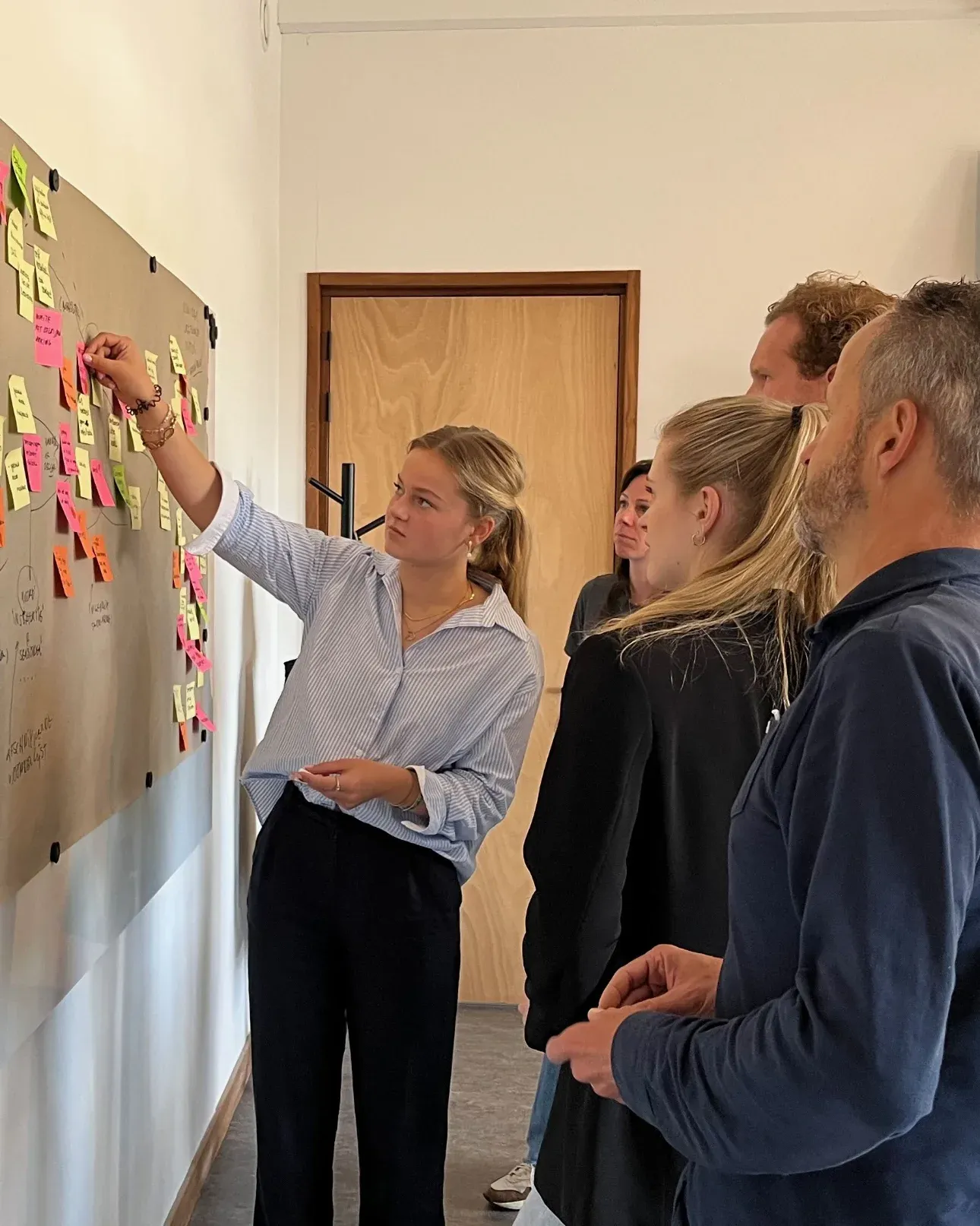
A workshop is not team building.
It is about the result, not about how many people were involved. The reflex mostly runs the other way: involve as many people as possible, so everyone feels heard. That is how a workshop turns into a consultation structure, and how a full day of work produces a summary instead of a decision.
So I keep it small on purpose. One team of five to seven people, everyone with a real stake in the case, and one facilitator. Facilitation is a skill, not a role you hand to whoever is available, and one facilitator keeping the group on the result beats three keeping it comfortable.
I have run 100+ sessions with teams at 50+ companies. The workshops that change something share the same shape: small team, own case, one facilitator, and an ending with owners and dates. For bigger groups there is a different format: a training when your team needs to learn the methodology, a keynote when you want to inspire a room.
Six workshops, one deliberate order.
This menu is not a pick list. The management table goes first: choose direction before anyone builds anything. Then your team takes over: design the model, sharpen the proposition, decide what to test. Few companies need all six workshops. Most start with one, and the intake tells us which.
Choose direction
Innovation Readiness, Innovation Strategy, Business Model Assessment.
See the workshops ›Design and validate
Business Model Design, Value Proposition Design, Assumption Roadmap.
See the workshops ›First, decide where innovation should go.
These workshops are for the people who own the decision. Where does innovation stand, what blocks it, and which directions deserve your innovation budget. Every workshop in this cluster follows the same pattern: a short intake beforehand, a working session, and a report with a direction you can defend afterwards.
Innovation Readiness
Where innovation stands in your organization and what blocks it, ranked. The honest starting picture, and often the start of a client relationship.
Innovation Strategy
A direction and an innovation thesis: where you will innovate, where you will not, and why. The end of scattered bets.
Business Model Assessment
Your current business model on one page, assessed: where value is created, where it leaks, and where it is vulnerable.
Then, build it and decide what to test.
These workshops are for the team that carries the idea, usually after a training. The tools are known; now they go to work on your own business. The three connect: design the model, sharpen the proposition, then decide what to test first.
Business Model Design
From business idea to a complete business model on the Business Model Canvas, with the weak spots named.
Value Proposition Design
What your customers actually value, mapped on the Value Proposition Canvas, and your offer redesigned to fit it.
Assumption Roadmap
Your model turned into assumptions, ranked by risk: what to test first, in what order, and why. The bridge to a sprint.
Fixed price, design included.
A workshop costs €4.500 per day, plus €250 for travel and materials, excl. VAT. Most workshops take one or two days; the intake settles how many. The quote contains the global workshop design, and the detailed design is part of my preparation, not a separate invoice. You know the full investment before we start.
A workshop runs at your office, or better, at an external venue where nobody gets pulled into a meeting. You can also come to my own workshop space at 't Patronaat in Helmond; there, venue and catering are included.
Outside 't Patronaat, the price excludes venue hire and catering. Books are also extra: with a full team and a book per person, that adds up, so the quote names them when they apply.
One team of five to seven people per workshop.
The pattern after 100+ sessions.
The workshops that produce results share three things: proper preparation, a small team, and a proper close. Preparation makes every hour of the workshop count. A small team means everyone at the table contributes and can actually decide. And a proper close names owners and dates, not intentions: you go home with a result you can execute.
I see the opposite regularly too: a big group, a loose question, and a wall of sticky notes nobody picks up on Monday. The format of my workshops is built against exactly that.
When a workshop is the wrong choice.
Your team has not learned the method.
A workshop assumes the tools are known. If the Business Model Canvas is new to half the table, the day goes to teaching instead of results. Do a training first.
See the training ›You want everyone involved.
If the goal is that twenty people feel heard, book a keynote instead: one session that inspires the whole room. A workshop is one team and a result.
You need evidence, not a plan.
A workshop ends with decisions and a plan you can execute. Proving the idea works takes weeks of real experiments, and that is a sprint.
You do not know what is blocking innovation.
Then choosing a workshop is guessing. Start with an Innovation Blocker Session: 90 minutes that name the blockers and what addresses each.
See the Blocker Session ›The plan is made? Now get evidence.
Workshop
One or two days with your own case on the table. Your team leaves with a result and a test plan: what to test first, and why.
Sprint
Two to twelve weeks. I co-design the experiments, your team runs them, and every phase ends with a verdict: persevere, pivot, or stop.
See how a sprint works ›Ready to put your own cases on the table?
Name the workshop you have in mind, or tell me where your team is stuck and I will tell you which one fits, or whether you need one at all. I read every request myself and reply with whether I think I can help.