The Strategyzer Connection
Looking for someone who can teach your team the Business Model Canvas, the Value Proposition Canvas, or Testing Business Ideas? I am one of 19 official Strategyzer coaches worldwide, and the only one in the Netherlands.
But Strategyzer is not the whole toolkit. Some questions need the canvas. Others need a different framework entirely. My work is applying the right one to the question you actually have, whether it carries the Strategyzer name or not.
25+ years of business experience. 15 years with the Business Model Canvas. 100+ sessions at 50+ companies.
Trained at the source
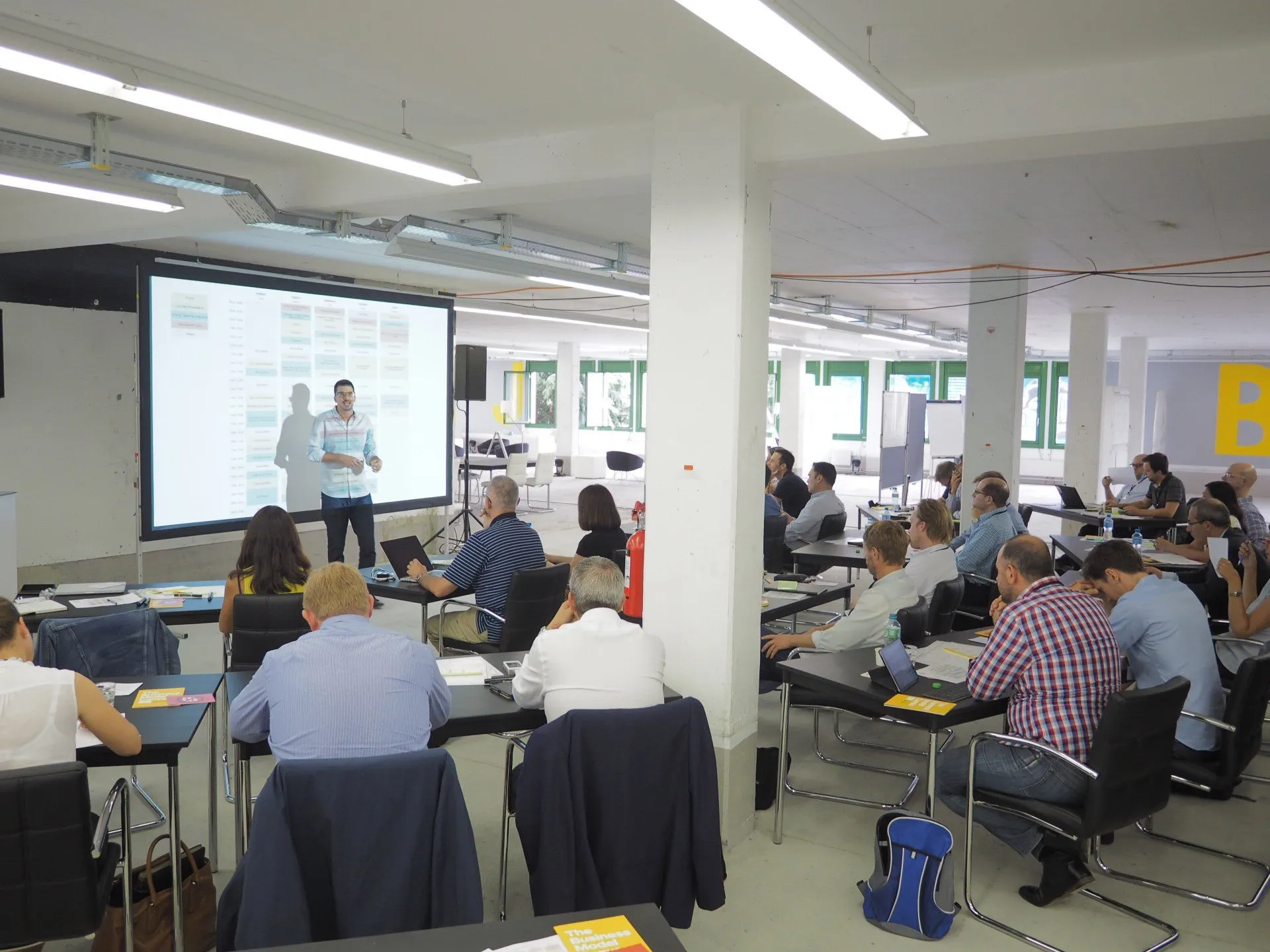
I was trained by Alexander Osterwalder and Yves Pigneur personally, in the very first Strategyzer bootcamp in Switzerland in 2016, alongside Greg Bernarda, co-author of Value Proposition Design, and people who later wrote Testing Business Ideas (David Bland) and The Invincible Company (Fred Etiemble). Since 2017 I have done client work on behalf of Strategyzer.
I first used the Business Model Canvas in practice in 2011, five years before the bootcamp, on a cloud platform that had already burned more than a million euros and two years of a mixed team's time. That day it became clear the problem was never in the product. It was in the model. Nine building blocks that had never been brought in line with each other.
More on that in my story.
The Strategyzer toolkit
Each of these four is genuinely good at something. Each also has a blind spot. Here is how I use them, and where I stop trusting them.
Business Model Canvas
Nine building blocks on one sheet: who you serve, what you offer, how you deliver it, what it costs, and where the money comes from. Its real strength is speed and shared language. A finance director, a product manager and a sales lead who have argued past each other for months will agree on where the disagreement actually sits within an hour.
The canvas describes your model, not the environment it lives in. Competition, market shifts, regulation, your own ability to execute: none of them are blocks on the canvas. That is a deliberate design choice, and it is the most common reason a beautiful canvas turns out to be wrong.
Value Proposition Canvas
The zoom lens on two of the nine blocks: customer segment and value proposition. Customer jobs, pains and gains on one side; products, pain relievers and gain creators on the other. It forces you to say out loud who you are for and what you are relieving them of.
The Value Proposition Canvas is a design tool, not evidence. A team can fill it in perfectly and still be describing a customer they invented in the room. The canvas is only as good as the customer conversations underneath it, and most teams skip exactly those.
Testing Business Ideas
The part of the toolkit most teams have heard of but never actually run. A test card turns an assumption into an experiment with a defined metric and a threshold you agree on before you look at the result. A learning card records what you found and what you decided next.
The experiment library leans toward consumer-speed feedback loops: landing pages, ad tests, quick surveys. In industrial companies with an 18-month sales cycle and a buying committee of six, half of those experiments do not fit, and redesigning them around your customer's procurement calendar is most of the work.
The Portfolio Map
From The Invincible Company: your innovation bets plotted across explore and exploit, on one map. It shows in one picture what project lists hide: where your resources actually sit, which bets have evidence behind them, and how thin the explore side of your portfolio really is.
The map shows you the picture. It does not create the governance that acts on it. I have seen leadership teams produce an honest portfolio map, recognise that 90 percent of their resources sit in exploit, and then change nothing, because no one owned the decision to kill anything.
Is your organization ready to innovate?
The tools above all live in the explore world: designing business models and value propositions, then testing them with experiments. Most established companies are built for the opposite world, exploit: running and improving the existing business. The organizations that win at innovation are good at both at the same time. That is the ambidextrous organization, and very few companies are one by accident.
This is where innovation readiness comes in. Moving from a training or a workshop to actually applying the methodology, from designing a canvas to running the experiments that test it, asks something of your organization: time, mandate, budget, governance, people who are allowed to explore. A brilliant canvas in an organization that is not set up for innovation produces a pleasant day and no change.
Kodak is the classic example. They understood digital photography and had the business model clarity. They failed anyway, because the organization was never made ready to explore what it already knew.
So when a company asks for a Business Model Canvas workshop, I ask why first. Sometimes the canvas is exactly right and we start there. Sometimes the real constraint is readiness, and I will say so before you book, not after. If that is your situation, the innovation readiness assessment is the better starting point.
Entry is simple, growth is custom
The engagement model starts productized: a training with a fixed program and a fixed price, easy to decide on. The further up you go, the more the work is designed around what the diagnosis reveals.
| Format | Duration | What you leave with |
|---|---|---|
| Training | 1 or more days | The methodology, learned on a fictional case so your own case does not get in the way. Applying it to your business comes next, in a workshop. |
| Workshop | 1 or 2 days | A result on your own cases: a strategy, a business model, a value proposition, or an assumption roadmap. Plus the action items to run it. |
| Sprint | 2 to 12 weeks | Your riskiest assumptions tested, with evidence. Every phase closes with a verdict you can defend to a board: persevere, pivot, or stop. |
| System | 12 months | An innovation operating system installed over twelve months, while your team learns to run it on real cases. That is why it sticks. |
| Advisory | Monthly | One day of my thinking per month after we have worked together: sparring sessions, a decision log, and a quarterly portfolio review. |
You learn the Strategyzer methodology itself in a training: in-company with your own team, or in a public masterclass. The Business Model Innovation Masterclass and the Testing Business Ideas Masterclass each run as two-day editions, taught in Dutch at 't Patronaat in Helmond, eight seats per edition. Current dates and the in-company modules are on the training page.
What you learn is yours. I do not train the same team on the same methodology twice. A workshop or a sprint is a different matter: the result there comes precisely from having an external facilitator in the room, someone whose only job is the outcome. And a system is built once, in twelve months; getting the most out of it afterwards is what advisory is for.
From masterclass to advisory.
“We tried everything: marketing agencies, more sales people, new strategies. Nothing worked. Then two workshop days with Ton gave us a completely new business model. And actual results. We're sitting down with over 100 municipalities. Our B2C channel is thriving. And our service is now accessible to thousands of older adults.”

Bas van der Kolk started with a two-day masterclass in 2023, continued with an innovation project, and works with me in an advisory relationship today.
A strategy day built on preparation
Earlier this year the general director of a fast-growing specialist consultancy asked me for a strategy day. What the first conversation surfaced was more specific than the request: a leadership team with no shared picture of their own business model and no process to turn observations into choices. So I designed the day around preparation, and each director mapped the model individually two weeks in advance. By mid-afternoon on the day itself they had a three-year goal with metrics, a set of strategic concepts, and a 12-month roadmap with owners and dates. They run their strategy reviews without me now.
What I am not
I am not Strategyzer. This is my own practice. I do not sell their platform, their licences or their subscriptions, and I have no commercial interest in whether you buy them.
I am also not the cheapest. There are trainers, coaches and consultants who will run a canvas session for half my rate. Before you book one, ask how many sessions they have actually run, and what changed at the companies afterwards. A cheap session that changes nothing is the most expensive kind there is.
And when a company simply asks me to deliver a Business Model Canvas training, I say yes. That is often how a relationship starts. Where I am worth the money is the harder case: when you know innovation is stuck, you are not certain why, and picking the wrong tool would cost you a quarter.
Frequently asked questions
What is Strategyzer?
Strategyzer is the Swiss company founded by Alexander Osterwalder and Yves Pigneur, the creators of the Business Model Canvas. They publish the canvases and the book series (Business Model Generation, Value Proposition Design, Testing Business Ideas, The Invincible Company), run programmes, and sell a subscription platform for innovation teams. The canvases themselves are free to download from strategyzer.com.
Are you Strategyzer certified?
There is no certification programme for Strategyzer coaches, so the honest answer is that nobody is. Coaches are selected and trained by the creators: I was trained by Osterwalder and Pigneur personally at the first bootcamp in 2016, and since 2017 I have done client work on behalf of Strategyzer. You will find me on the Strategyzer coaches page. I do hold Strategyzer course certificates, like anyone who completes one of their programmes. So when someone says they are "Strategyzer certified," they are describing a certificate of completion, which is a different thing.
What does a Strategyzer workshop cost in the Netherlands?
My day rate is €4.500 plus €250 for travel, accommodation and materials. A workshop runs one or two days with one team of five to seven people. In-company training is €750 per person per day plus venue, catering and travel costs. The public masterclasses cost €1.475 early-bird or €1.675 regular per person for two days, all-inclusive; a team of four joins for €5.900. Longer engagements, sprints and systems, derive from the same day rate, and the exact price follows once the statement of work aligns expectations. The Strategy Call that starts every engagement is free.
Do I need a paid Strategyzer subscription to work with you?
No. The canvases are free, and everything I run works on paper, on a wall, or in whatever digital whiteboard your company already pays for. If you are already a Strategyzer platform customer I will work inside it. If you are not, there is no reason to become one for my sake.
Where do I download the canvas and the test cards?
Directly from the Strategyzer library. Both the Business Model Canvas and the Value Proposition Canvas are free PDFs. The test cards and learning cards come from Testing Business Ideas, and Strategyzer publishes downloadable versions there too.
What is the difference between the Business Model Canvas and the Value Proposition Canvas?
The Business Model Canvas maps your whole business across nine blocks. The Value Proposition Canvas zooms into two of them, customer segment and value proposition, and examines the fit between what your customer is trying to get done and what you actually offer. Start with the business model when the question is "does this business work". Start with the value proposition when the question is "does anyone want this".
Is the Business Model Canvas still relevant in 2026?
Yes, for what it was designed to do: creating shared language across functions, fast. What has changed is the expectation. Fifteen years ago the canvas itself was the insight. Now most teams can fill one in unaided, so the value has moved to what happens next, testing the assumptions the canvas exposes and building the governance to act on the results.
Can you run sessions in Dutch?
Yes. Dutch and English, and I switch between them in the same room when a group needs it. The public masterclasses in October and November are taught in Dutch; slides, materials and books are in English. The canvas terminology stays English (customer jobs, pains, gains) because that is how Dutch teams already use it.
A Strategy Call is 30 minutes.
You bring your situation. I bring pattern recognition from 100+ sessions at 50+ companies. You leave with a sharper picture of what is actually blocking your innovation, whether we work together or not. No pitch. If I am not the right fit, I will say so.